Research Centers and Labs
Research Centers and Labs
Our Facilities
The Clarkson community utilizes a variety of state-of-the-art facilities to conduct impactful research in electronics, aerospace, biotechnology, health, safety and security, mechanical systems, energy generation, storage and manufacturing technology and sustainable development.
Research Centers
Clarkson University's Center for Advanced Materials Processing's (CAMP) supports companies interested in understanding and exploiting state-of-the-art, advanced, tailor-designed materials and processes to improve their products, solve manufacturing challenges, increase yield, lower costs and foster innovation.
The C3S2 mission is to encourage and facilitate research and educational opportunities in the area of complex, nonlinear, dynamical and adaptive systems. The C3S2 will foster collaboration from an interdisciplinary group of researchers to address important problems from a wide range of scientific, technological and engineering disciplines for the advancement of technology and humanity.
CAARES brings together world-class expertise, focusing on air and water sensing, sampling, physical and chemical analysis, fate and transport modeling and the application of computational fluid dynamics to air and water pollution problems.
The Center for Electric Power System Research (CEPSR) provides high quality research and education programs that address the technological challenges of the transition to a clean, low carbon power grid.
Explore CEPSR
CITeR is the only National Science Foundation (NSF) Industry/University Cooperative Research Center (IUCRC) focusing on serving its affiliates in the rapidly growing areas of identity science and biometric recognition through interdisciplinary group of faculty, researchers, and students.
The Center for Rehabilitation Engineering, Science and Technology (CREST) educates, mentors and trains students to integrate and apply a combined scientific, analytical, technological and business approach to emerging biomedical engineering and biomedical science areas.
The Center of Excellence in Healthy Water Solutions is co-lead by Clarkson University and SUNY College of Environmental Science & Forestry. It delivers synergistic problem-solving on the wide range of water issues impacting New York State and beyond.
Research in Action
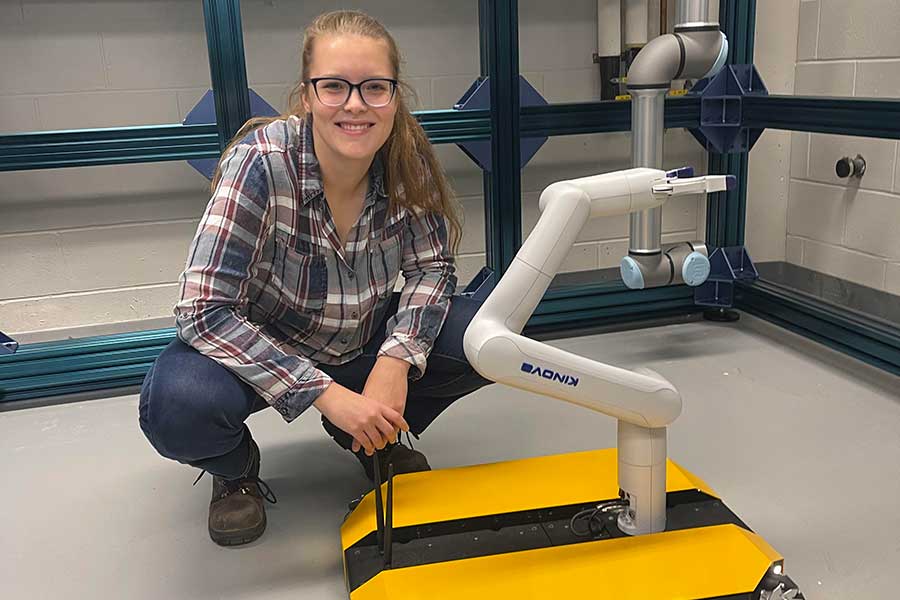
Megan Michaud, an undergraduate researcher in Clarkson’s Astronautics and Robotics Laboratory (ASTRO Lab), received a NASA Award for satellite testbed research.
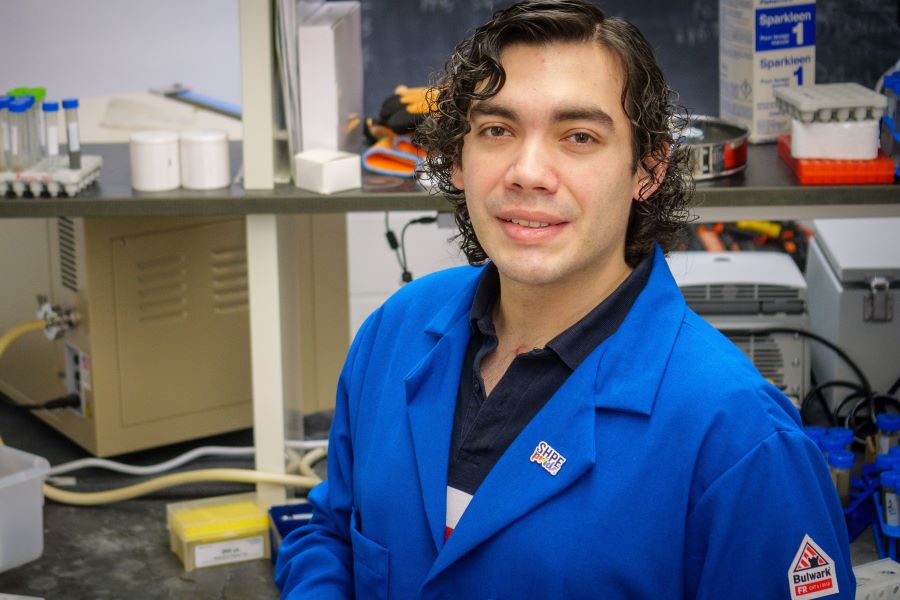
Environmental Science & Engineering student Victor Manuel Melgarejo Cazares recently received the Society of Hispanic Professional Engineers (SHPE) PRIDE Scholarship. His research focuses on the remediation of PFAS-contaminated soil.
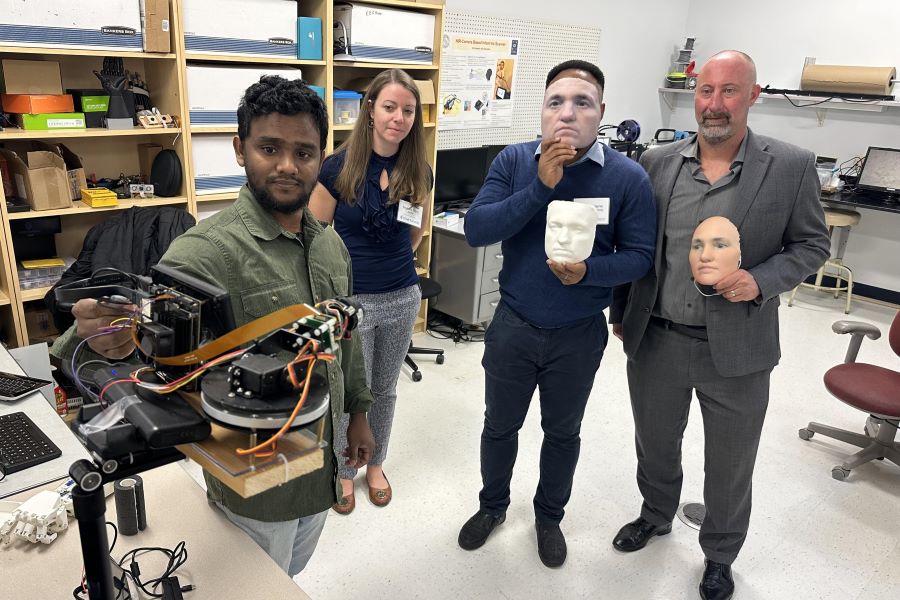
The Center for Identification Technology Research (CITeR) welcomed government and industry partners from around the country to review CITeR research occurring in the areas of biometric identity, deepfakes, and security.
Laboratories
Campus Location: CAMP 228
Faculty: Michael Bazzocchi
Description: The Astronautics and Robotics Laboratory explores advanced concepts and performs innovative and transformative research in science and engineering. ASTRO Lab trains high-quality researchers and engineers, develops new technologies, and provides novel solutions to problems in astronautics, robotics, and society.
Campus Location: Clarkson Science Center 250
Faculty: Erik Bollt
Description: We focus on applied dynamical systems, especially as informed from datasets, computation and experiments. This strongly overlaps with data science, big data, network science, inverse problem methods (including optimization), uncertainty quantification and Bayesian perspectives, information theory, machine learning and problems related to model reduction. Our interests in dynamical systems, data analysis and scientific computing have included both topical developments and pursuant scientific applications. This allows us to interact with scientists and problems in many exciting areas. Topical interests in dynamical systems and complex systems come through “data enabled science” that combines traditional applied mathematics and data analytics. Applications include oceanography, physiology, civil and mechanical engineering, bio-informatics, social science, mathematical biology, physics and brain science. Our sponsors have included the ARO, Office of Naval Research (ONR), Defense Advanced Research Projects Agency (DARPA), National Science Foundation (NSF), National Institutes of Health (NIH), NASA and the Department of Energy (DOE).
Campus Location: CAMP 275
Faculty: Chunlei Charles Liang
Description: The CHORUS Lab is a team for computational solar physics with main computer facilities located in CAMP 275. In the CHORUS lab, fast and accurate computational codes were developed on unstructured grids for predicting convection and dynamo in stars and planets. The PI is an expert in the high-order Spectral Difference method for solving compressible flow equations. Both graduate and undergraduate students are trained to become computational scientists and engineers. Furthermore, the team is building a reduced-order modeling tool for predicting solar magnetic cycles.
Campus Location: CAMP 275
Faculty: Chunlei Charles Liang
Description: The CMH Lab is a computational team with main computer facilities located in CAMP 275. In the CMH lab, both Large Eddy Simulation (LES) and Unsteady Reynolds-Averaged Navier-Stokes (URANS) techniques are used on unstructured grids. The PI is an expert in both the high-order Spectral Difference method and the pressure-based Finite Volume Method. Both graduate and undergraduate students are trained to become computational engineers for marine hydrodynamics and wind turbine aerodynamics. Furthermore, the team optimizes designs of canoe paddles, marine propellers, and wind turbines.
Campus Location: Clarkson Science Center 176G
Faculty: Andreas Wilke
Description: In the Evolution and Cognition Lab, we examine how natural selection has shaped the cognitive mechanisms underlying human decision-making behavior during periods of risk and uncertainty. We study how these mechanisms operate in areas such as risk taking, mate choice and foraging for food and information.
Campus Location: Science Center 170A
Faculty: Dipankar Roy
Description: This research lab is equipped with a broad range of modern instruments and facilities for quantitative electroanalytical characterizations of a broad range of functional materials and devices based on these materials. Research conducted in the lab is focused primarily on novel materials for electrochemical energy storage/conversion and semiconductor device fabrication. Electrochemical characterization techniques are frequently coupled with optical methods, such as surface plasmon resonance spectroscopy, as well as with CAMP-based analytical facilities of electron microscopy and X-ray diffraction. The Electroanalytical Characterization Lab provides comprehensive hands-on research opportunities to graduate and undergraduate students at Clarkson University.
Faculty: Lisa Legault
Description: In the Motivation & Emotion Lab, we study how motivation affects social perceptions, relationships and behavior. We ask questions like "What type of motivation promotes the open-minded perception of others?" and "What is the best way to motivate people to reduce prejudice?". We examine these questions in relation to adaptive self-regulation, such as the regulation of bias and negative emotion.
Campus Location: Technology Advancement Center 103 & Schuler ERC 2012
Faculty: Elizabeth Pienkos
Description: Members of the Phenomenology Lab explore the subjective experience of mental disorders, as well as human experience more generally. By carefully examining what it is like to experience oneself, other people and the world, we may enhance our ability to predict, prevent and treat mental illness.
Campus Location: Science Center 262
Faculty: Michael Ramsdell
Description: The Physics Team Design Lab provides first-year STEM students with advanced group projects designed around a challenging real-world laboratory design experience. Approximately 10% of the class is typically enrolled. Students usually work in groups of four throughout the semester to develop a model that can accurately predict the motion of a toy car traveling along an arbitrarily shaped track (Physics I) and the motion of an electric train powered by an arbitrary voltage source (Physics II). During the final week of the semester, groups compete to test the predictive capability of their models during a series of challenge sessions.
Campus Location: CAMP-CB2210
Faculty: Maria Gracheva
Description: This computational laboratory is equipped with several multicore workstations adapted for high performance computational work with the use of MPI (parallel computing) in a Linux environment. We develop physical computational models with both custom codes and commercial software. The research conducted on these workstations mostly deals with problems related to biotechnology and nanotechnology, such as the identification and characterization of biomolecules with nanopore-based solid-state devices, including DNA sequencing and nanoparticle’s characterization. Other projects include filtering, manipulation and separation of biomolecules and nanoparticles in general. Graduate and undergraduate students working in our lab learn about modern supercomputing, gain access to national computational resources through our lab and work at the cutting edge of computational nanotechnology, biophysics and computational modeling and simulation.
Campus Location: Near the Potsdam Airport
Faculty: Michael Ramsdell
Description: Clarkson's Reynolds Observatory is home to two telescopes. The 12-inch telescope is used for both bright star spectroscopy and narrow-field-of-view imaging. The smaller 5-inch telescope, which has a field of view slightly larger than the full moon, is used for wide-field-of-view imaging. The precision telescope mount enables long exposures necessary for observing deep-sky objects. Current projects include studying the time variability of various types of binary stars using both spectroscopy and photometry, as well as photometric studies of nebula in the search for emissions caused by polycyclic aromatic hydrocarbons.
Faculty: Tom Langen, Acting Chair
Description: In the Social Development and Health Psychology Research Lab, we examine how social pain negatively impacts mental and physical health, as well as how people determine when to offer help or express concern when they see someone experiencing health problems.
Faculty: Sean Banerjee and Natasha Banerjee
Description: The Terascale All-Sensing Research Studio (TARS) at Clarkson University, co-directed by Dr. Sean Banerjee and Dr. Natasha Banerjee, performs research in human-driven artificial intelligence, using capture and analysis of dense multi-person interactions in online and real-world environments. Research at TARS spans the fields of computer vision, linguistics, deep learning, robotics, computer graphics, human-computer interaction and software engineering. TARS has received Clarkson University's first NSF CISE Research Infrastructure grant, in the amount of $746,000 which is being used to build Clarkson's first markerless motion-capture facility. The studio has been fully designed and constructed by Dr. Sean Banerjee, Dr. Natasha Banerjee and student Nikolas Lamb. At full capacity the studio will house 240 high-speed cameras, 16 multi-modal sensors, 16 microphones, 16 thermal sensors and a dense array of force plates for full-range understanding of multi-person human interactions. The studio also houses multiple 3-D printers (both Cartesian and delta), 3-D scanners, VR systems and single-board computer-based capture systems. At any given time, the studio supports the research of 30+ undergraduate students who have gone on to receive internships and full-time positions at GE, Google, Epic, Ensign-Bickford Industries, AIS, Air Force Research Laboratory, CACI International, Kitware, SRC, Qualcomm, Veritas Prime, and Hewlett-Packard. Students have also had REUs (Research Experiences for Undergraduates) at Carnegie Mellon, Lehigh, TU Darmstadt and Temple and attended graduate schools, such as Duke, Lehigh and the University of Michigan.
Campus Location: CAMP 275
Faculty: Goodarz Ahmadi
Description: The TMFL is a virtual lab with main computer facilities located in CAMP 275. The primary objective of the TMFL is to provide a fundamental understanding of the mechanisms that control turbulent multiphase flows, including the transport, deposition and removal of particulate matter. The TMFL develops predictive models for the behavior of dilute and dense turbulent multiphase flows, including aerosols and granular flows. Another main goal is to provide a detailed understanding of the effect of particle shape and size on particle deposition and removal, as well as of the dynamics of multiphase systems.