Center for Air and Aquatic Resources Engineering and Sciences (CAARES)

Center for Air and Aquatic Resources Engineering and Sciences (CAARES)
Addressing Complex Environmental Challenges

The Center for Air and Aquatic Resources Engineering and Science (CAARES) at Clarkson University is a state-of-the-art analytical instrumentation facility capable of performing trace level organic contaminant analyses. 

The facility houses numerous chromatography-mass spectrometry-based instrumentation capable of analyzing both polar and non-polar organic contaminants CAARES has modernized legacy pollutant measurements by developing efficient sample processing and analysis procedures.  

CAARES has also developed non-targeted analysis (NTA) techniques with the use of state-of-the-art systems such as GCxGC-HRMS as well as the development of in-house data mining software tools. CAARES is also a leader in the analysis of PFAS and is a DoD-ELAP and New York State certified laboratory for EPA Method 1633. CAARES operates as a core facility providing research support for both internal and external researchers.

Current and Recent Research

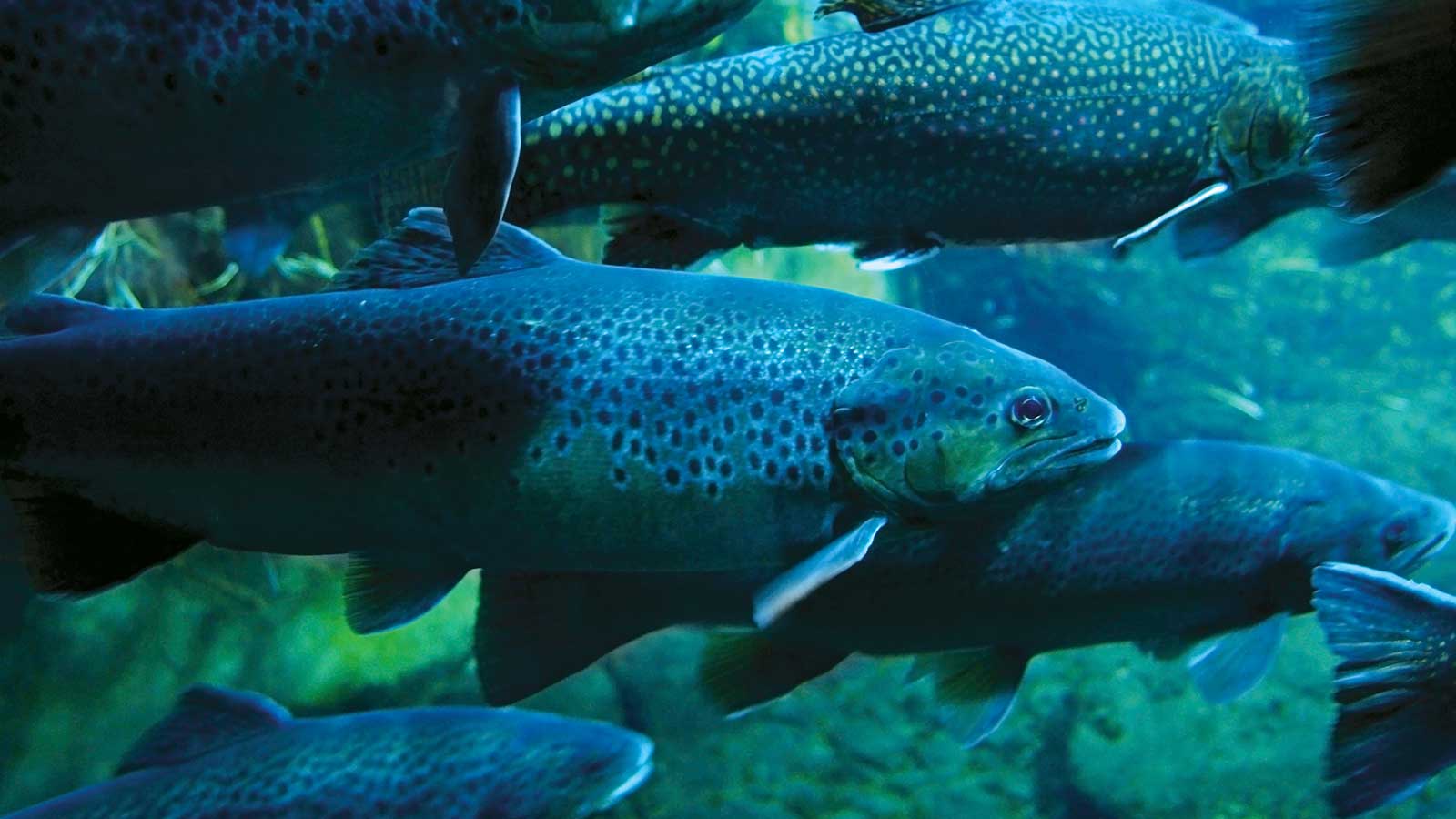
Great Lakes Fish Monitoring and Surveillance Program

This program is the revision of a program started in the 1970’s with the objective of monitoring fish contaminants in the Great Lakes. In this program, the sampling has been simplified, and additional emphasis has been placed on identifying emerging contaminants that may pose a risk to the Great Lakes. Clarkson has operated this program since 2005, and we have modernized legacy pollutant measurements by developing efficient sample processing and analysis procedures. Some of the legacy pollutants analyzed include PCBs, PBDEs, and dioxins/furans whereas emerging contaminants include PFAS, hexabromocyclododecane (HBCDD) and chlorinated paraffins (Cl-Pars). CAARES has also developed non-targeted analysis (NTA) techniques to further enhance the program with the use of state-of-the-art systems such as GCxGC-HRMS as well as the development of in-house high-resolution MS data mining software tools. We have also enhanced the program by developing working relationships with laboratories from other federal agencies, states and countries.

Toxic Chemical Signatures in Eastern National Parks Sports Fish

The National Parks represent some of the most pristine and protected landscapes in the     United States; however, they are not immune to the impacts of anthropogenic contaminants. CAARES has been collaborating with the National Park Service to assess the occurrence and impacts of both legacy contaminants, such as polychlorinated biphenyls (PCBs) and pesticides, emerging contaminants such as per- and polyfluoroalkyl substances (PFAS), and novel contaminants in sport fish from Eastern National Parks.

Factors influencing PFAS bioaccumulation and biomagnification in marine food webs associated with AFFF sources in a New England estuary

 CAARES has been collaborating with researchers from Dartmouth college to investigate the pattern and profiles of per-and polyfluoroalkyl substances (PFAS) bioaccumulated in lower trophic level marine organisms and transferred to higher trophic levels in marine food webs and to determine toxicity of less studied PFAS compounds.

Center of Excellence for Healthy Water Solutions

In collaboration with researchers from Clarkson University and SUNY College of Environmental Science and Forestry (SUNY ESF), CAARES continues to provide analytical support for monitoring environmental contaminants, including per- and polyfluoroalkyl substances (PFAS) and microcystins. These efforts focus on monitoring contaminants on water bodies, biota, and avian species, helping to better understand contaminant transport, environmental fate, and potential ecological risks.

1,4-Dioxane in Consumer Products

CAARES has been working with the New York State Department of Environmental Conservation (NYSDEC) for several years to analyze 1,4-dioxane, a potential human carcinogen, in a variety of consumer products. This work supports regulatory efforts to identify sources of exposure, evaluate compliance with state regulations, and protect public health by reducing the presence of this contaminant in products used by consumers.

CAARES supplies analytical services to a variety of customers including faculty from Clarkson, faculty from other universities, environmental consulting firms and start-up companies.

About CAARES

Learn more about our research center's efforts and collaborations:

DoD-ELAP Accreditation

CAARES currently holds an ISO/IEC 17025:2017 and US Department of Defense Environmental Laboratory Accreditation Program certification for testing of PFAS using EPA Method 1633. CAARES routinely analyzes samples under the QA/QC requirements of this standard to produce high-quality data to support in-house research and external clients.

CAARES Equipment and Facilities

CAARES has analytical facilities that house a number of major instruments, as well as laboratory space specifically designed to support research. The analytical
instrumentation is capable of analyzing for polar and non-polar organics along with
metals and elements. The major types of instruments include liquid chromatography-
mass spectrometry (LC-MS), Gas Chromatography-Mass Spectrometry (GC-MS,
inductively coupled plasma-mass spectrometry (ICP-MS) and Ion Chromatography
(IC)/Combustible Ion Chromatography (CIC) systems.

Capabilities

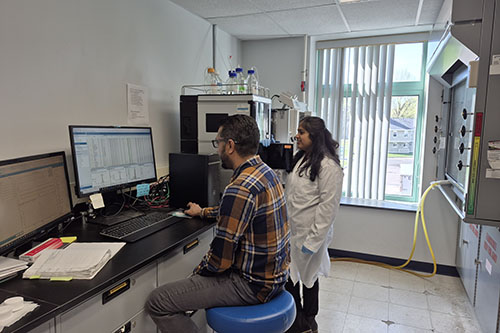
  • A Thermo Vanquish UPLC coupled to an Altis Triple Quadrupole Mass Spectrometer is available for targeted analysis of polar organic compounds in ESI or APCI modes. Instrument is typically used in Multiple Reaction Monitoring (MRM) mode for targeted analysis of polar organic contaminants including PFAS.
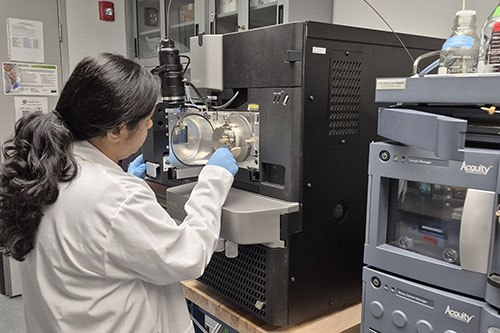
  • A Waters Xevo Absolute Triple Quadrupole LC-MS system is available for the targeted analysis of polar organic contaminants including PFAS.
  • A Sciex X500B Quadrupole Time-of-Flight (QToF) High Resolution Mass Spectrometry is available for accurate mass measurement (>20,000 res). The instrument can be used for both small (contaminants, metabolites) and large (polymers, proteins) molecule analysis.
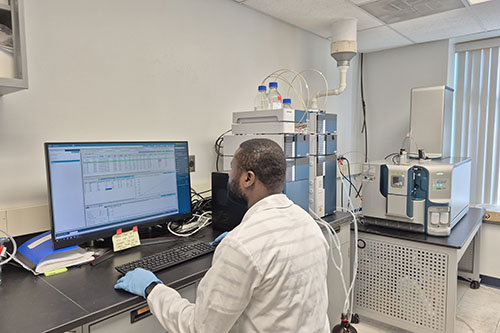
Single and Tandem Mass Spectrometry
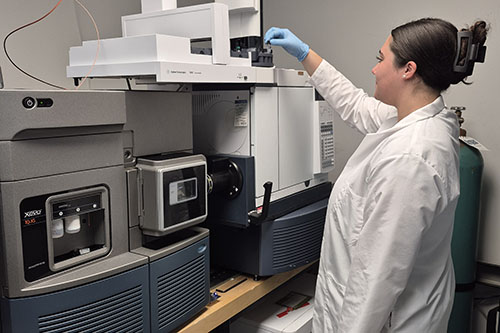
An Agilent 7890GC coupled to a 5977A MSD (single quadruple) is available for targeted analysis of volatile compounds. This instrument can be used coupled to a liquid injector or to a headspace sampler. A Waters Xevo TQ-XS triple quadrupole system is available for targeted analysis using MRM mode. The instrument is coupled to a GC using an atmospheric pressure chemical ionization source which is a soft ionization technique that creates stable molecular ions compared to traditional electron ionization. Legacy contaminants such as Dioxins/Furans, PCBs, PCNs and OCPs are routinely analyzed using this system.

Two-Dimensional Gas Chromatography-High Resolution Mass Spectrometry (GCxGC-HRMS)
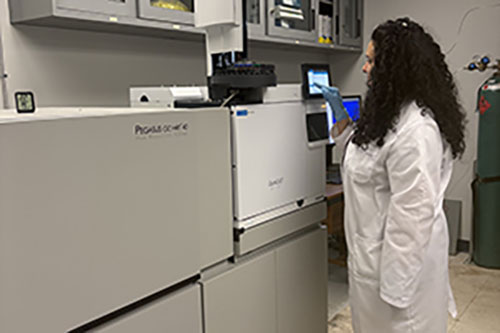
A GCxGC-HRMS system (LECO Pegasus GC-HRT + 4D system) is utilized for the non- targeted analysis of volatile contaminants in complex environmental media. This state- of-the-art system combines enhanced chromatographic separation with accurate mass measurement to help identify novel contaminants. The instrument can be operated in both electron ionization and chemical (positive/negative) ionization modes.
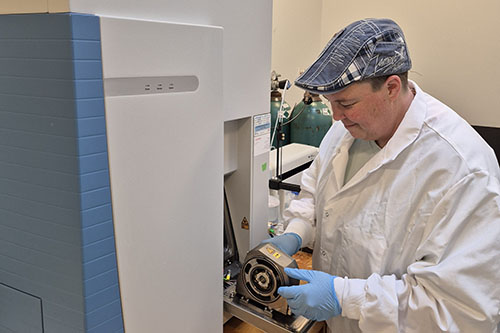
A Thermo iCAP-RQ ICP-MS system is available for elemental/metals analysis. The
instrument can be operated in kinetic energy discrimination (KED) mode to remove
interfering polyatomic species. The instrument is used for both environmental and
biological sample analysis.
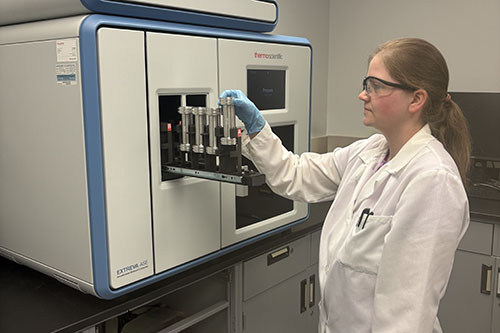
A Thermo EXTREVA accelerated solvent extraction (ASE) system is available for the extraction of a wide range of samples. This fully automated system can be used for in-cell cleanup and evaporation of extracts. 

Automated SPE systems are available for cleanup of legacy contaminants including PCBs, Pesticides and Dioxins as well as emerging contaminants such as PFAS.
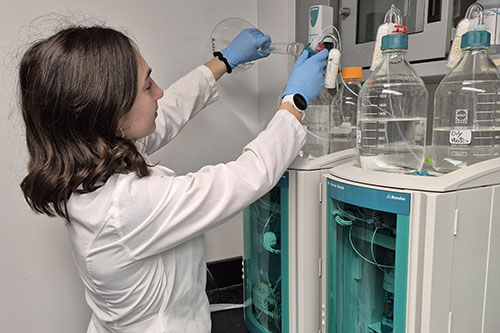
A Thermo Integrion IC is available for the analysis of cations and anions. A CIC from
Metrohm is available for Fluorine measurement including extractable organic fluorine
(EOF).

A Milestone DMA-80 is available for mercury analysis. Biological samples such as fish tissue and hair are routinely analyzed.

Our DIONEX ASE300 Accelerated Solvent Extraction system prepares organic samples for processing. This unit uses elevated temperature and pressure, permitting rapid extraction of the samples with a much smaller volume of solvent than a conventional Soxhlet extraction system.

The lab also has a Fluid Management Systems (FMS) PowerPrep SPE Automated One-Step Extraction and Concentration System and an automated gel permeation chromatography (GPC) system for handling multiple samples simultaneously.

A Shimadzu LC-2040C HPLC is available with a photodiode array (PDA) detector. The instrument is used for analysis of polar organic compounds.

Faculty and Staff

Many faculty from different departments collaborate with CAARES. In addition, we work closely with the Institute for a Sustainable Environment, where we also have faculty appointed.

Meet Our Faculty and Staff

CTA Block